Reducing Scope 3 emissions: A structured approach for supplier engagement

Scope 3 emissions are often the most complex part of a company’s decarbonisation journey. For companies looking to reduce these emissions, a new supplier engagement framework from Nexio Projects provides a structured way to improve data quality, identify the biggest sources of emissions and turn those insights into practical reduction actions.
The world currently emits more than 50 billion tonnes of greenhouse gases each year, with businesses and industry accounting for a substantial share of these emissions. These emissions are broadly classified into three categories: Scope 1, Scope 2 and Scope 3.
Scope 1 covers direct emissions from sources a company owns or controls, such as fuel burned in its factories and company-owned vehicles. Scope 2 covers indirect emissions associated with the generation of purchased energy, such as electricity, steam, heating and cooling. Scope 3 covers all other indirect emissions across a company’s value chain, including emissions from purchased raw materials and components, transportation and distribution, business travel, product use, and the treatment of products at the end of their life.
For most companies, Scope 1 and Scope 2 emissions reductions are relatively straightforward to identify and manage.
Scope 3 reduction
Reducing Scope 3 emissions, however, is different. The mechanics are fundamentally more complex because a company cannot directly control what happens across its value chain, particularly at its suppliers. It can only influence, request and incentivise change. This shifts much of the responsibility for Scope 3 reduction from a company’s own operations to the way it manages its relationships with suppliers.
That is where procurement becomes critical. Procurement is the function that selects suppliers, manages commercial relationships and makes purchasing decisions, giving it a direct channel through which to influence suppliers and embed sustainability requirements into the supply chain.
Supplier engagement therefore becomes a key part of Scope 3 reduction, allowing companies to improve the quality of their emissions data while also identifying and implementing measures to reduce emissions at source, such as switching to renewable energy, improving energy efficiency, changing production processes or using lower-carbon materials.
Procurement therefore serves as an important bridge between a company’s sustainability ambitions and the suppliers that can help turn those ambitions into measurable Scope 3 reductions.
A 5-phase approach for supplier engagement
Building on our expertise in sustainability, having delivered over 1,000 sustainability projects at 400 clients across in over 20 countries, we have developed a framework for supplier engagement in the context of Scope 3 roadmaps.
Phase 1: Equipping the procurement team
Supplier outreach only works when the people making the request understand what they are asking for. Before any data request goes out, the procurement team should be equipped with a standardised question list adapted by product category, guidance on handling supplier pushback, and clear criteria for what constitutes usable data.
This phase should be completed before outreach begins. Its goal is to prevent repeated follow-up loops between sustainability teams, consultants and suppliers, and to ensure procurement can lead the conversation with confidence.
For companies that also use third-party sustainability assessment platforms as part of their supply chain engagement toolkit, the same principles apply: requests should be clearly defined, consistently communicated and aligned with the broader supplier engagement strategy.
Phase 2: Data collection across suppliers
Standardised data request templates should be adapted by product category and material type, rather than rebuilt for every supplier. Suppliers should receive structured support throughout the collection period, ideally routed through the existing procurement relationship rather than through a new point of contact.
The output of this phase should be a complete set of supplier datasets, with each dataset assessed for data confidence before any calculations are performed. A response confirming that no data exists is more useful than silence. It identifies where data improvements are needed and provides a starting point for future supplier engagement.
Building a data confidence framework
Rather than treating all incoming data as equivalent, every dataset should be assessed at intake using a clear confidence framework:
High: Supplier-specific, documented activity data that can be used directly in calculations.
Medium: Sector-adjusted or partially verified data that can be applied with documented assumptions.
Low: Benchmark-based estimates that are explicitly flagged and used with clear caveats.
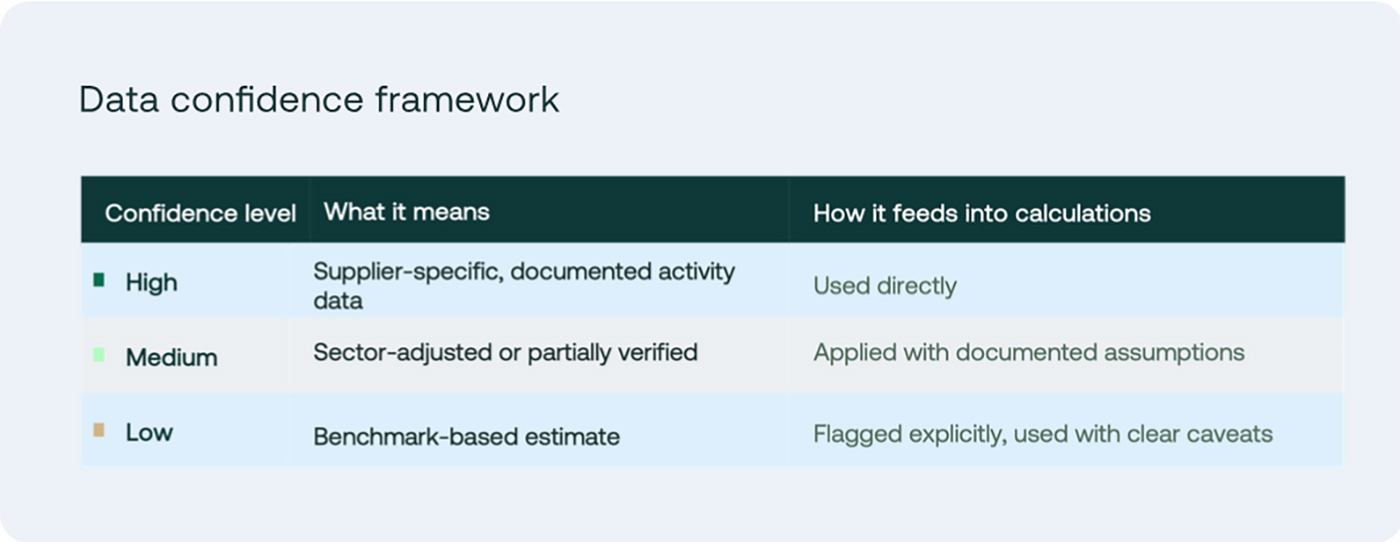
Every dataset should carry a complete audit trail. Each number should be linked to its source, underlying assumptions and confidence level. At an early stage of supply chain emissions maturity, many responses will fall into the medium-confidence category. That is a starting point for improvement, rather than a reason to delay the analysis.
Phase 3: GHG calculations and hotspot identification
The next step is to calculate product-level greenhouse gas emissions, or product carbon footprints (PCFs), for the suppliers and products within the defined scope. Where suppliers provide verified PCFs, these can be used directly. Where they do not, emissions can be calculated using available energy data, input data and processing information.
Calculations should be consistently applied across suppliers to maintain comparability. The resulting analysis can identify emissions hotspots at the material, supplier and geographic level. Two suppliers producing the same product in different regions may have substantially different carbon footprints, depending on factors such as the local energy mix, production processes and upstream sourcing.
This level of granularity is important because it turns emissions data into information that can support targeted reduction planning.
Phase 4: Identifying reduction opportunities
Calculating emissions by supplier and product group is the foundation. The real value comes from using those results to identify practical opportunities for emissions reduction.
For each supplier in scope, an initial set of reduction levers can be derived directly from the hotspot analysis. Each lever should be assessed across three dimensions: its potential relevance for reducing emissions, its practical feasibility given the supplier’s context and available data, and its priority for further investigation and follow-up.
Geography can matter as much as material inputs. Two suppliers producing the same product may face very different reduction pathways depending on where they operate. A supplier in a region with a carbon-intensive energy mix may have fundamentally different decarbonisation options from one with access to renewable energy infrastructure. Sourcing regions, transport routes and upstream input choices can all influence what is realistically achievable.
Every reduction lever should be documented with an audit trail covering the assumptions and confidence levels behind it. This allows procurement teams to enter supplier conversations knowing not only what actions could be considered, but also why they are relevant and how much weight can be placed on the underlying analysis.
The output of Phase 4 is a prioritised set of reduction opportunities for each supplier, ready to feed into supplier action plans.
Phase 5: Supplier action plans
The analysis should ultimately be consolidated into a consistent-format supplier action plan for each supplier. Each plan should include:
- An indicative emissions footprint by material and upstream production stage
- Priority areas for follow-up and potential reduction levers
- A methodology section covering assumptions, data sources, confidence levels and interpretation guidance
Using a consistent format enables comparison and steering across the supplier portfolio. Procurement teams can use the plans directly in supplier conversations, while sustainability teams can use the underlying calculations to inform emissions targets, reduction pathways and forecasting.
The format should be designed so that both teams can understand the analysis and act on it without requiring extensive additional interpretation.
Deciding who to engage: The prioritisation matrix
With hundreds or thousands of suppliers in a portfolio, deciding who to engage first is a strategic decision.
A prioritisation matrix can help companies assess suppliers across two core dimensions: emissions impact, based on their contribution to Scope 3 emissions, and spend and influence, based on factors such as annual purchase value and the strength of the commercial relationship. This creates four broad engagement tiers:
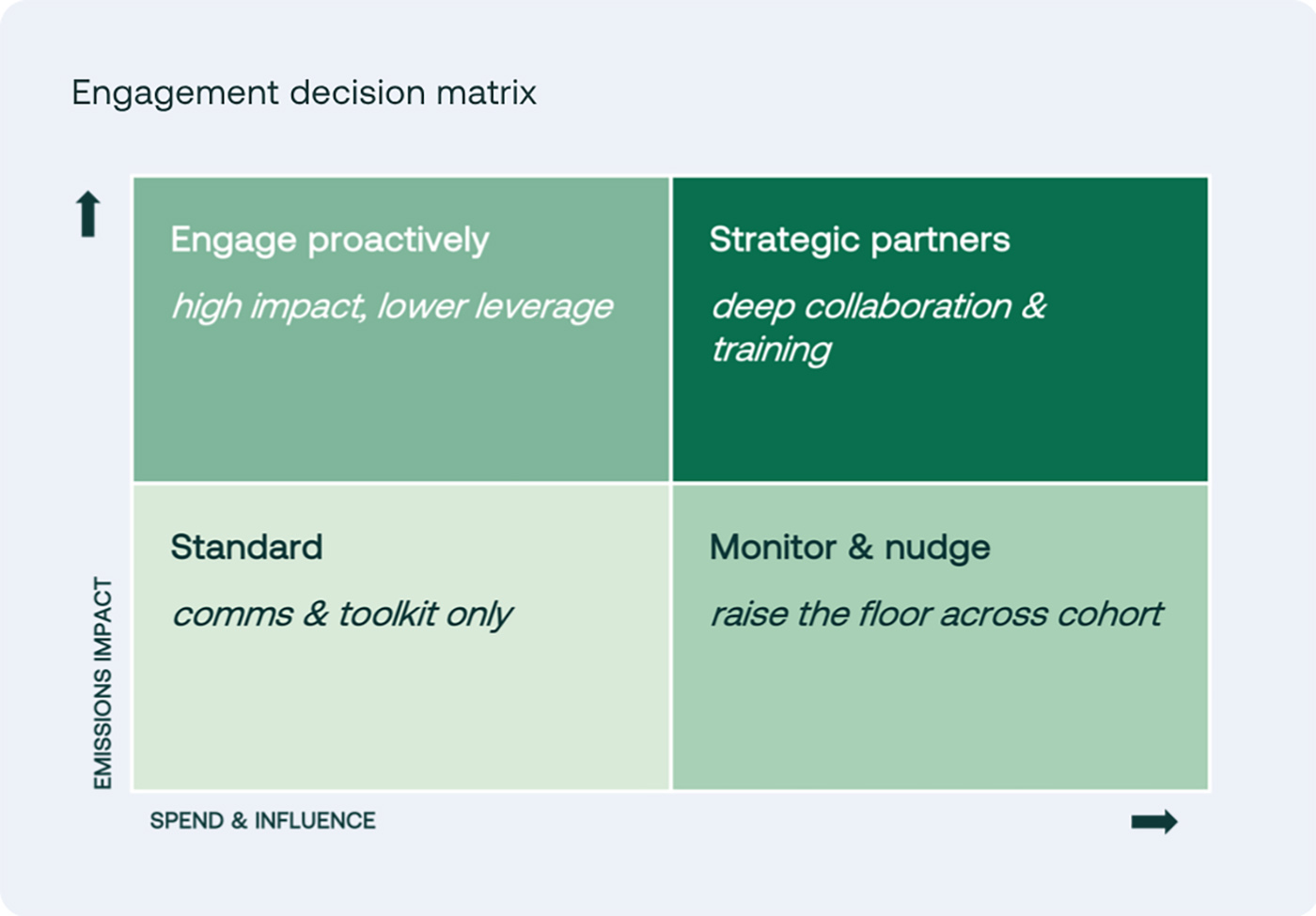
Strategic partners: High emissions impact, high spend. These suppliers warrant the deepest level of engagement, potentially including shared decarbonisation pathways, joint training, regular data exchange and dedicated emissions reduction plans.
Proactive engagement: High emissions impact, lower spend. These suppliers remain a priority for emissions data collection and reduction efforts, even where commercial leverage is more limited. Engagement should be consistent, structured and based on realistic expectations around supplier capacity and response rates.
Monitor and nudge: Low emissions impact, high spend. These suppliers may be important commercial relationships, but they are not necessarily the primary focus of Scope 3 reduction efforts. Standardised engagement, periodic data requests and targeted follow-up may be appropriate.
Standard communications: Low emissions impact, low spend. These suppliers can generally be managed through standardised data collection tools, templates and communications. Follow-up should be proportionate to the potential emissions impact and available resources.
The matrix can be further refined using additional prioritisation factors, including strategic importance, such as suppliers with significant potential for future commercial growth; risk exposure, including regulatory, geographic and supply continuity risks; and data maturity, reflecting how prepared a supplier is to provide reliable emissions information.
The result is a more targeted engagement strategy: resources can be concentrated where supplier engagement has the greatest potential to improve emissions data and drive meaningful Scope 3 reductions, while lower-priority suppliers can be managed through more standardised processes.
Conclusion
Reducing Scope 3 emissions requires more than collecting data from suppliers – it requires a structured process for turning that data into action. By equipping procurement teams, improving data quality, identifying emissions hotspots, prioritising reduction opportunities and translating them into supplier action plans, companies can make their Scope 3 efforts more targeted and practical.
The key is to focus resources where they can have the greatest impact, while building stronger supplier engagement and progressively improving the quality of emissions data over time.