Niki Serruys (The Ensur Company) on Belgium’s transforming insurance sector

Belgium’s insurance market is becoming increasingly complex as regulation, digitalisation, changing customer expectations and legacy systems reshape the sector. Niki Serruys from The Ensur Company discusses how insurers are adapting to these changes and the opportunities they create for technology, specialisation and further growth.
Belgium may not be Europe’s largest insurance market, but it is certainly one of its more intricate ones. European regulation is layered with local legislation and taxation, the pension landscape has its own specificities, and brokers continue to play a particularly important role in distribution.
For international insurers and technology providers, entering the Belgian market therefore requires considerably more than simply adapting an existing European model.
That complexity is according to Niki Serruys, Country Manager for Belgium at The Ensur Company, one of the defining characteristics of the market. It increases the operational burden and creates a relatively high barrier to entry, but it also makes genuine local expertise particularly valuable.
“As regulation, technology and changing customer expectations increasingly converge, insurers need to turn that expertise into organisations, processes and systems that can keep adapting”, says Nikki.
That evolution is changing The Ensur Company as well. Having built its foundations in transformation consulting, the company is expanding its capabilities across compliance, data and technology. That increasingly means moving beyond analysing change and managing its implementation to actually building parts of the solution.
“We used to be primarily consultants. Today, we are for instance also becoming software builders. That changes what we can deliver to our clients and, ultimately, what it means to be a consultant.”
What makes Belgium such a particular insurance market?
“Two things stand out. The first is distribution. Brokerage plays a much bigger role in Belgium than in many neighbouring markets, particularly in non-life. Insurers therefore have to think both about their relationship with the end customer and how they interact with intermediaries.”
“The second is regulation. European legislation already creates a substantial regulatory layer, but on top of that you have Belgian legislation, taxation and specific rules around areas such as the second and third pension pillars.”
“I often hear the same thing from insurers or solution providers considering entering Belgium: supporting this market requires a significant investment. You have to understand local legislation, products and distribution practices, while Belgium itself is not enormous. That creates a relatively high barrier to entry. But if you really understand the Belgian market, that local knowledge becomes a competitive advantage. It is expertise that an international player cannot simply copy and paste from another country.”
“We will increasingly see two successful models, with large generalist insurers and specialist insurers with bespoke solutions.”
Does that complexity also explain why the Belgian insurance market has consolidated?
“It is certainly one of the factors. Insurance companies have to do an enormous amount of work simply to remain compliant. Requirements come from different authorities at European and Belgian level and do not necessarily use the same definitions, formats or data structures. So you need specialised people, processes and IT support.”
“For smaller insurers, that burden weighs proportionally much more heavily. They may need many of the same capabilities as a much larger organisation, but have far less volume over which to spread the cost. In life insurance, there has historically been an additional financial pressure from portfolios containing older policies with high guaranteed interest rates.”
“Digitalisation has added another investment cycle. Customers increasingly expect the level of digital service they receive elsewhere, requiring insurers to invest in backend systems, portals, integrations and data. Regulation, financial pressure and technology therefore reinforce each other. For some smaller players, the combined investment becomes increasingly difficult to sustain.”
Does that mean scale is becoming indispensable?
“Not necessarily. I think we will increasingly see two successful models. Large generalist insurers can use their scale, distribution networks and operational efficiency to compete across a broad range of products. Specialist insurers, on the other hand, can understand a particular profession, customer segment or type of risk exceptionally well and tailor their products, underwriting and pricing accordingly.”
“What becomes more difficult is sitting somewhere in between. If you do not have scale, you need a very clear reason why customers or intermediaries should choose you. Neither model is inherently better, but insurers will have to become much clearer about where they want to compete and what they want to be known for.”
What does Belgium’s strong broker market mean for digitalisation?
“It means that digitalisation cannot be limited to the end customer. Brokers need quick access to information, they need to be able to follow the status of a case and they need efficient interaction with the insurer. Telling a customer that it may take another two or three weeks because the broker is still waiting for the insurer, is becoming much harder to accept in a digital environment.”
“That does not mean digital channels will bluntly replace personal interaction. Sometimes customers want to sit down with an adviser and at another moment they may be sitting on their sofa on a Sunday afternoon and expect to handle something themselves. That is why I believe in an optichannel model: allowing customers and intermediaries to interact in the way that makes most sense at that particular moment.”
What will help insurers unlock the full potential of new technology?
“A lot comes back to the legacy environment. Almost every insurer is exploring AI today. The discussion has moved beyond whether AI will matter. It will. The question is how to make it work within an actual insurance organisation. And that is where companies run into practical limitations. Can we access the necessary systems? Is the data of sufficient quality? Can we integrate new solutions safely into the existing architecture?”
“That matters because insurers are under constant pressure to improve operational efficiency. A significant amount of capacity is already absorbed by an increasingly demanding compliance and reporting framework, while many organisations also have an ageing workforce and know that experienced employees will leave over the coming years.”
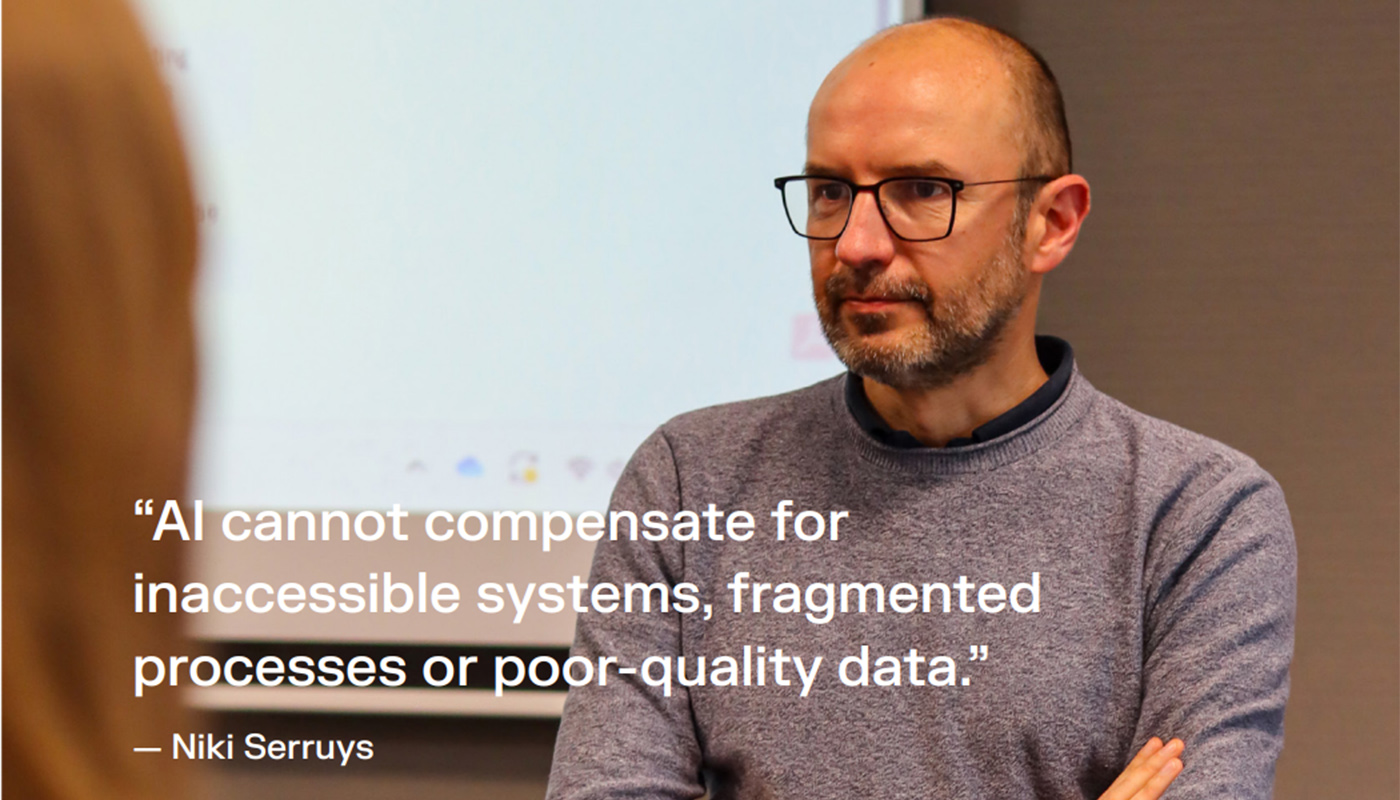
“Simply adding more people is therefore neither an efficient nor a sustainable answer. Insurers need to find ways to handle more policies, claims and regulatory requirements with fewer manual interventions. Technology can play an important role in creating that capacity, but AI cannot compensate for inaccessible systems, fragmented processes or poor-quality data. If insurers want to use new technology to free up people for the work where their expertise adds most value, the foundations have to be right.”
Are you already seeing AI deliver tangible results?
“Yes, although we should keep the current stage of development in perspective. With major technological shifts, we tend to overestimate what they will change in the short term and underestimate their longer-term impact. There is a great deal of experimentation today, but we are already seeing useful applications in areas such as fraud detection, underwriting and the faster processing of relatively straightforward claims.”
“The bigger change will come when AI becomes deeply integrated into core insurance processes and backend systems. That is where I expect the real long-term productivity gains. The first benefits are visible, but we are still at the beginning.”
What changes are you seeing in life insurance and pensions?
“Belgium is a mature life insurance market, so without major regulatory or fiscal changes you should not expect spectacular jumps in overall growth. Group insurance and occupational pensions have a somewhat different dynamic. People increasingly realise that they will have to take greater responsibility for their retirement income, which increases the importance of the second pillar for employees and the self-employed.”
“Longevity adds another dimension. People can spend twenty years or more in retirement. Traditionally, much of the focus has been on accumulating capital until retirement, but that increasingly long period afterwards creates its own needs around income, healthcare, savings and succession. That’s an opportunity for insurers to develop products and services specifically for that stage of life.”
How is all of this changing The Ensur Company?
“Our growth is not about growth for its own sake. We grow to remain relevant and to serve our clients better. Part of that is geographical: we have built a strong base in Belgium and the Netherlands and want to build on that. But growth is just as much about broadening our capabilities.”
“Ensur started in transformation consulting and has progressively added expertise in areas such as compliance and data. Our ambition is to support clients across a larger part of their transformation journey. We do not want to become a company that tries to do everything. We want to expand where it makes sense around our core insurance expertise, so that we can bring together the right capabilities for increasingly complex assignments.”
“For our clients, that means fewer handovers between different partners and teams that understand both the insurance challenge and what it takes to turn change into practice.”
Is that also why Ensur is increasingly building software itself?
“Yes. It is a natural extension of how our clients’ needs are evolving. Traditionally, our role was to analyse a problem, design the solution and support its implementation. If software development was required, an IT partner would typically take over that part.”
“Today, that boundary is becoming much less rigid. Our data team is developing applications and our own data migration tooling, and we are also building solutions for specific client needs. That allows us to go further than defining what needs to be done: where it adds value, we can now help create the solution as well.”
“I think that is also where consulting is heading. Clients increasingly need people who can connect business, insurance expertise and technology rather than treating them as separate disciplines. For us, deep insurance knowledge remains the starting point, but we can combine it with transformation, data and software capabilities to deliver something tangible. That combination is becoming an increasingly important part of what The Ensur Company brings to the market.”
Finally, what will distinguish the insurers that succeed?
“Above all, their ability to move. An insurer with a solid architecture, accessible systems and high-quality data will be able to use AI, integrate new solutions and adapt its processes much faster. An insurer with a great deal of legacy still to resolve will have to spend significant resources simply catching up. For some organisations, that investment pressure may become another driver of consolidation. For others, it will create an opportunity to move ahead.”
“That brings us back to what makes Belgium so interesting. It is a complex market, and that complexity is not going away. But complexity does not have to be a disadvantage. If you understand it, organise around it and build the right capabilities, it can become precisely what sets you apart.”