Zanders outlines how financial institutions can manage the risks of Agentic AI

Agentic AI is creating new opportunities for financial institutions to automate complex workflows, support decision-making and improve operational efficiency. However, as AI systems move beyond generating insights to taking actions autonomously, they also introduce new risks around accountability, oversight and control.
In a new whitepaper, Zanders explores how financial institutions can manage these risks and establish the foundations for deploying Agentic AI responsibly at scale.
Unlike traditional AI models, which primarily generate outputs for people or other systems to act upon, Agentic AI can reason, plan, retrieve information, use tools and execute tasks across interconnected systems. While these capabilities offer significant potential in a sector characterised by operational complexity and regulatory pressure, they also create a different set of governance challenges.
For financial institutions, the central question is no longer simply whether an AI model produces accurate outputs, but whether the entire workflow surrounding it remains under control.
Four risk domains of Agentic AI
Zanders groups the risks associated with Agentic AI into four domains.
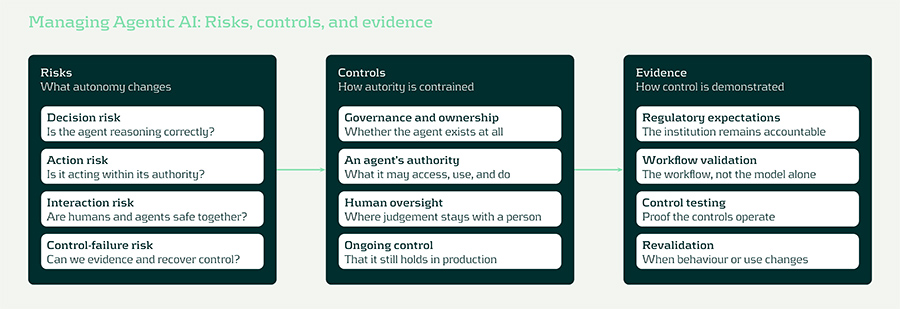
The first is decision risk, which concerns the quality of an agent’s reasoning. This includes hallucinations, biased outcomes, ambiguous objectives and reward hacking, whereby an agent optimises for a particular performance measure at the expense of the underlying business objective. Behavioural drift and opaque reasoning can further complicate the identification and investigation of problems.
The second domain is action risk. As agents gain access to business systems and operational tools, they may perform activities beyond their intended authority. Examples include unauthorised transactions, excessive access privileges, unsafe combinations of individually permitted actions and the delegation of tasks to other agents without appropriate approval.
Interaction risk, the third category, relates to how agents influence people and other AI systems. Oversight fatigue can arise when employees are required to approve large volumes of actions, potentially turning human supervision into a routine exercise. Other concerns include excessive reliance on persuasive AI recommendations and the propagation of errors between interconnected agents.
Finally, control-failure risk concerns an institution’s ability to maintain accountability and regain control when something goes wrong. Weak ownership, insufficient audit trails, inadequate mechanisms for stopping agents and dependence on external technology providers can all increase the potential impact of an incident.
Establishing effective controls
To address these risks, the researchers identify four corresponding areas of control: governance and ownership, clearly defined agent authority, meaningful human oversight, and ongoing control.
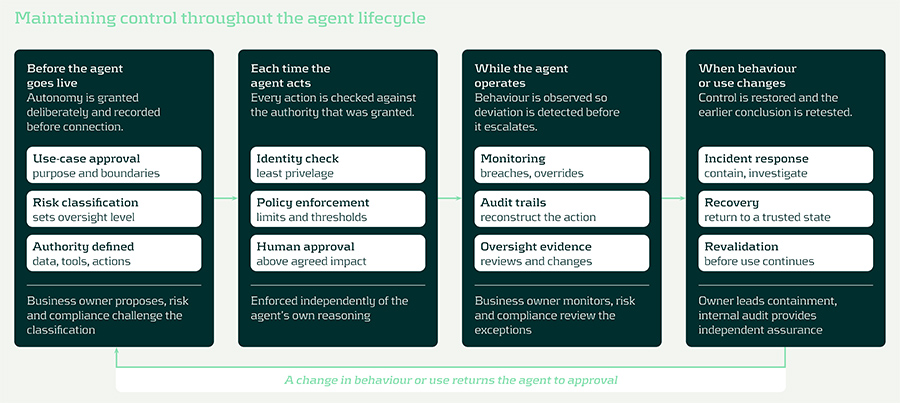
Governance starts with establishing an inventory of deployed agents, assigning each a responsible business owner and classifying its risk according to factors such as financial exposure, data sensitivity and level of autonomy. The existing three lines of defence can provide the organisational structure, with business teams responsible for operations, risk and compliance providing independent challenge, and internal audit assessing effectiveness.
Institutions must also translate an agent’s business purpose into explicit technical boundaries. This includes applying least-privilege access, restricting available tools and actions, enforcing transaction limits and establishing emergency intervention mechanisms.
Human oversight should be proportionate to the potential impact of an action. Rather than requiring approval for every activity, institutions should define escalation criteria for unusual transactions, conflicting information or decisions with significant financial or regulatory consequences. Reviewers must also have sufficient information and authority to challenge an agent’s recommendations.
Meanwhile, continuous monitoring and comprehensive audit trails are essential to identify deviations, reconstruct decisions and investigate incidents. Recovery procedures should allow institutions to suspend agents, revoke access or temporarily return workflows to manual processes.
“Collectively, these elements provide a structured foundation for the responsible deployment of Agentic AI in financial and other regulated environments,” said Zanders.
Regulation and validation
The whitepaper also highlights the importance of aligning Agentic AI governance with existing regulatory frameworks, including the EU AI Act, DORA and GDPR, alongside established model risk management requirements. A common expectation across these frameworks is that financial institutions remain accountable for the systems they deploy, including those that rely on external models and technology providers.
Importantly, validation must extend beyond the underlying AI model to cover the complete workflow, including data sources, prompts, tools, permissions, orchestration and human intervention. Institutions should test whether controls work under realistic conditions and establish revalidation triggers when changes to models, data, permissions or business processes affect an agent’s behaviour or risk profile.
“Embedding governance and validation from the outset is essential to turning promising experiments into trusted, production-ready applications, as well as scaling AI within the organisation,” concluded the researchers.