Agentic AI in procurement: ‘Organization and process matter as much as technology’

Finding the right way to approach AI can be daunting for Chief Procurement Officers (CPOs). When automating procurement, organizations have a lot to gain from deploying agentic AI – but it requires a strategic, carefully planned process design, according to insights from Inverto.
Unlike traditional AI tools that merely recommend a course of action, agentic AI tools are capable of carrying out tasks on their own across several systems. For example, they can read a requirement, qualify a supplier, run a sourcing event, issue a purchase order, and match the invoice from start to finish.
However, the technology is not a panacea. Agentic AI can only operate effectively where decision-making rules are clearly defined and documented, including explicit thresholds, escalation mechanisms for human intervention and well-established compliance boundaries. Informal practices and tacit knowledge, such as relying on the judgement of an experienced colleague, are insufficient foundations for deploying autonomous AI agents at scale.
Inverto gives the example of a routine purchase order approval: While an Outlook chatbot might draft an email asking a category manager for sign-off, it ultimately relies on human approval. An autonomous agent, however, bypasses this manual step. It verifies the requisition against SAP Ariba policies, independently issues the purchase order, and only brings in a human if a preset limit is exceeded.
Expanded to wider procurement processes, agents can interpret requirements, evaluate suppliers, manage sourcing events, assess bids and issue purchase orders. These activities can be performed autonomously, provided agents operate within clearly defined parameters and governance frameworks. This is where organisations risk falling short.
Process, not technology, is the obstacle
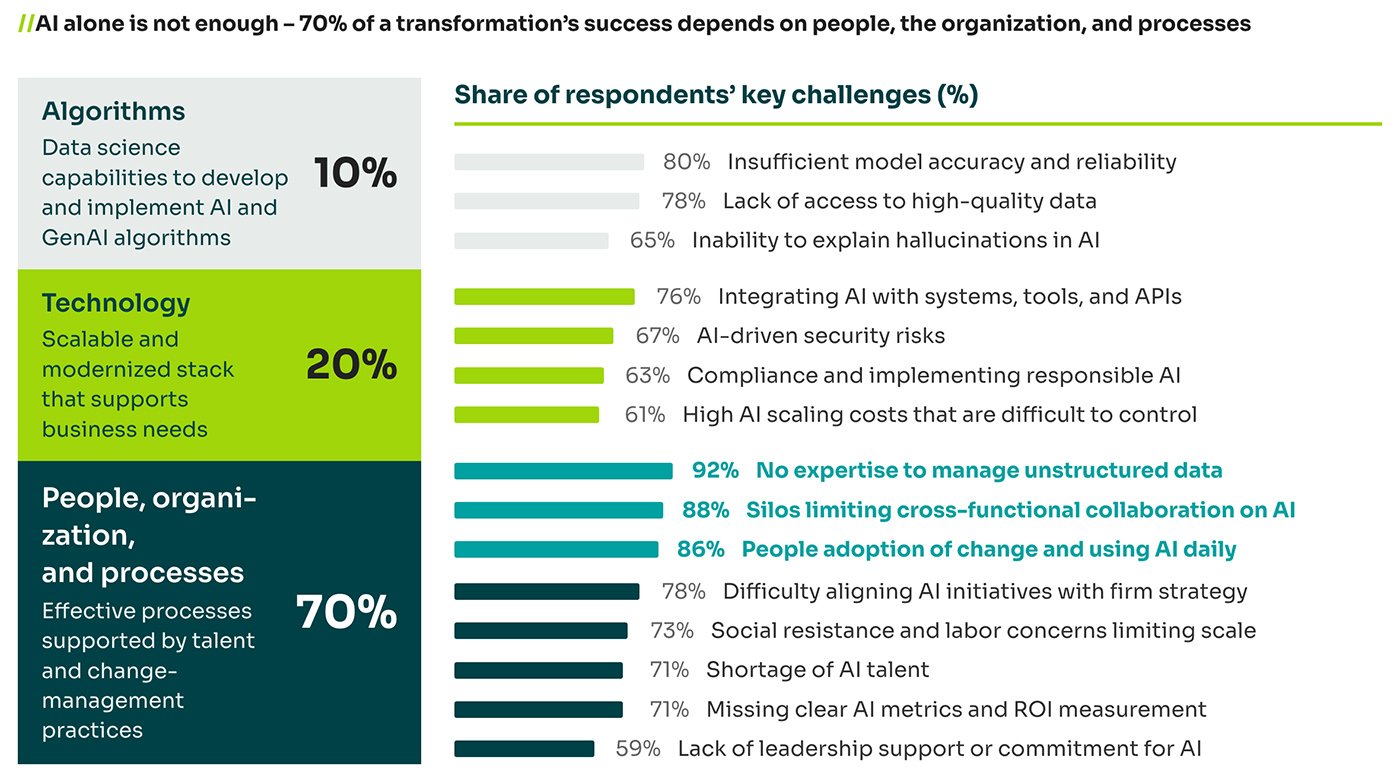
The authors argue that the technology is largely mature and that the real obstacle is clarity about how work gets done. They point to a Boston Consulting Group study finding that 70% of an AI transformation’s success depends on people, organization, and processes, compared with 20% for technology and 10% for algorithms.
Choosing the right decisions to automate
Inverto suggests three tests for deciding what to hand over. Can a wrong decision be cheaply undone? Does the outcome depend on a relationship software cannot hold? Does the law require a human to be involved?
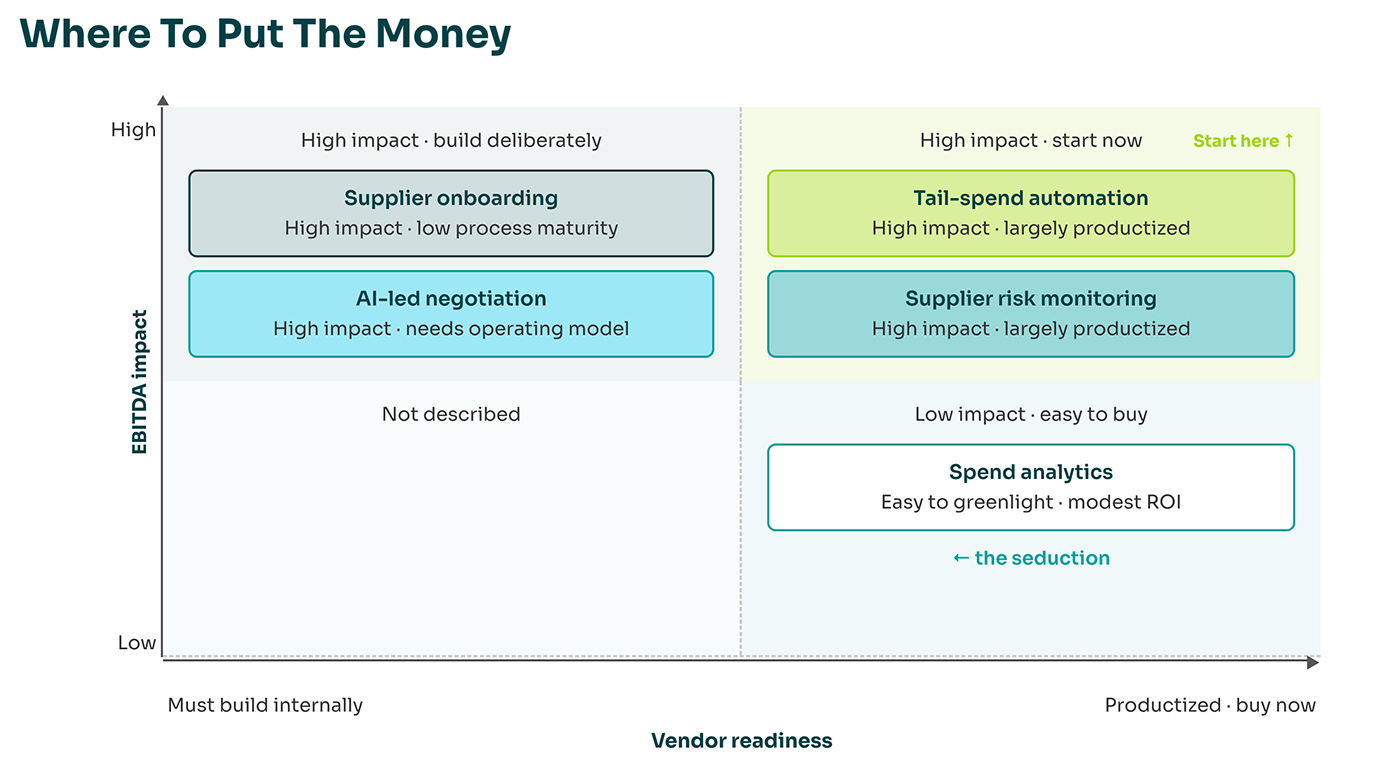
By those measures, tasks such as catalog ordering, invoice matching, and tail-spend sourcing are likely to be automated, while humans should still be at the wheel for tasks like strategic negotiations, make-or-buy choices, and crisis management.
One client example shows the potential. An AI screening tool reviewed more than 700 purchase requests in a year and challenged roughly half. The result was €1.2 million unlocked, or about 6% on the spending addressed.
Why projects disappoint
Inverto attributes most failures to organizational causes. Some companies expect full independence on day one, even though one study of live systems found that 74% still relied mainly on human evaluation. Others treat AI as a substitute for process work, when it demands more of it. Still others confuse visibility with impact, favoring easy-to-buy spend analytics that deliver modest returns.
The authors warn that writing down every rule can be uncomfortable. Senior buyers whose value has rested on judgment nobody else can replicate may discover that, in policy terms, this means logic the organization does not have. In these cases, the CPO and the chief human resources officer should address this openly, before deployment, and frame it as ‘your judgment becomes policy’ rather than a threat to roles.
What to do in the first 90 days
Inverto recommends running a small pilot and a broader review of processes at the same time, rather than one after the other. Within 30 days, leaders should scope a tail-spend pilot in one category group and commission a review of the top five indirect categories. By day 60, the pilot should be under contract and the review should have found its first policy gaps.
By the end of the 90-day period, the pilot should be live with close human supervision, and the review should be shaping the rules for scaling up. The pilot proves the idea works, the authors said, while the review builds the foundation for growth.
“Compliance is not an enforcement problem. It is a design problem,” notes the Inverto insight. “When the easy path and the compliant path are the same path, maverick behavior disappears, not because anyone is watching, but because there is nothing to deviate to. That principle does not stop at tail spend. It applies equally to supplier onboarding, contract management, and internal approvals.”
“Every time an organization asks why people are not following the process, the honest answer is usually that the process was never the path of least resistance.”