Central and Eastern Europe gains ground in Europe’s supply chain landscape

Far from serving merely as a low-cost alternative for companies moving goods across Europe, Central and Eastern Europe (CEE) has become a strategic part of the continent’s supply chain landscape. That is the conclusion of a new report by advisory firm Miebach and real estate group iO Partners.
While the region was once valued primarily for its lower labour costs, it is increasingly recognised for its solid infrastructure, strategic location, skilled workforce and growing adoption of automation. Czechia, Poland, Slovakia, Romania and Hungary continue to attract investment, offering companies a combination of cost efficiency, resilience and flexibility close to Europe’s largest consumer markets.
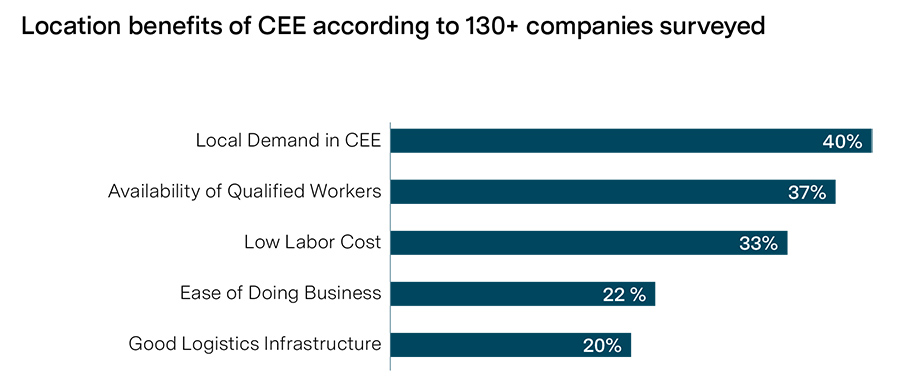
The study by Miebach and iO Partners cites a survey of 130 companies active in the region, which found that access to local demand was the most frequently named benefit of establishing operations in Central and Eastern Europe, mentioned by 40% of respondents. The availability of qualified workers followed at 37%, while low labour costs were cited by 33%. Ease of doing business was identified by 22% of companies, and good logistics infrastructure by 20%.
A notable example of the region’s growing importance is DHL Group’s recently announced $450 million expansion in Central and Eastern Europe. Poland, Hungary, Romania and the Czech Republic are reportedly among the markets included in the logistics giant’s strategic growth plans through to 2030. DHL points to opportunities arising from the region’s growing number of emerging businesses, many of which require transportation and distribution services.
Lower costs, though the gap is narrowing
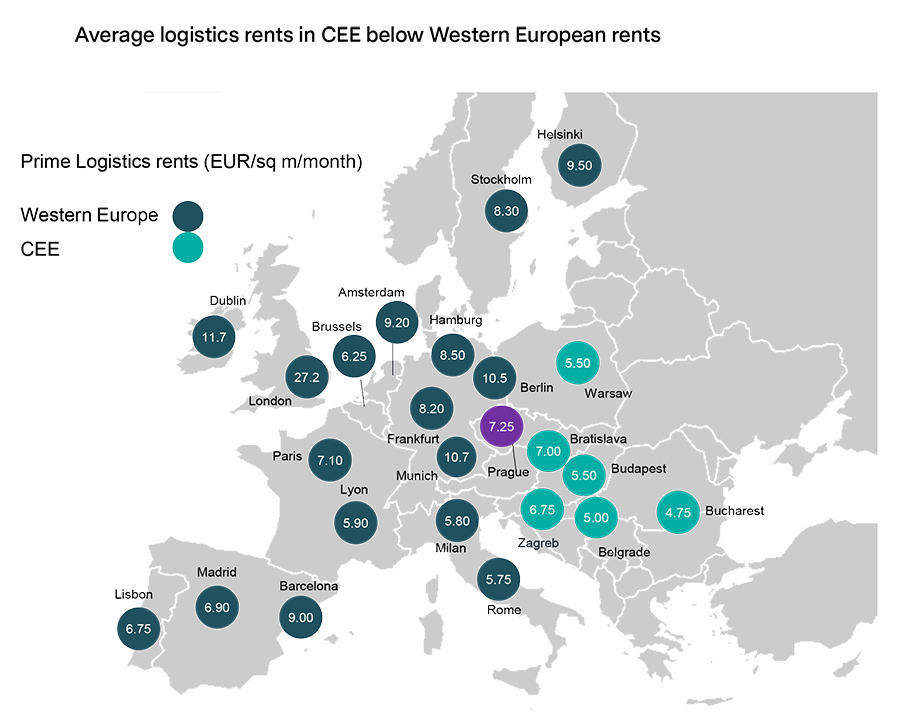
The report highlights that prices are consistently lower in the CEE region. Prime logistics space costs about €4.75 per square meter per month in Bucharest and €5.50 in Warsaw and Budapest. By comparison, the figure is €10.50 in Berlin, €10.70 in Munich, and €27.20 in London. Prague, at €7.25, sits in the middle of the range.
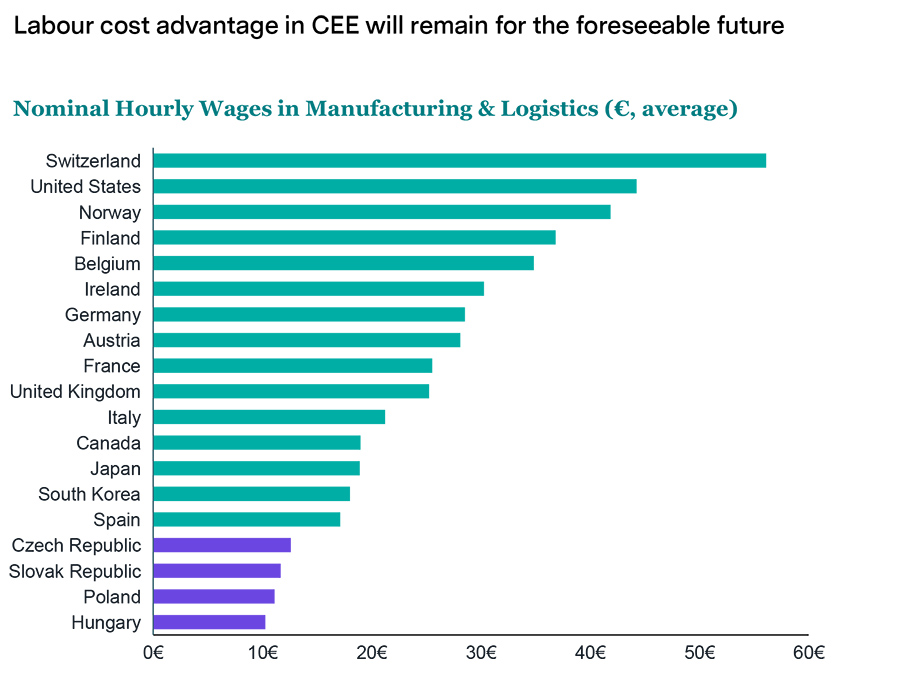
Meanwhile, labor also costs less for companies that look eastward. Hourly wages in manufacturing and logistics across the five countries are less than half of those in Western Europe, the report notes, and that is projected to remain the case for at least the next decade.
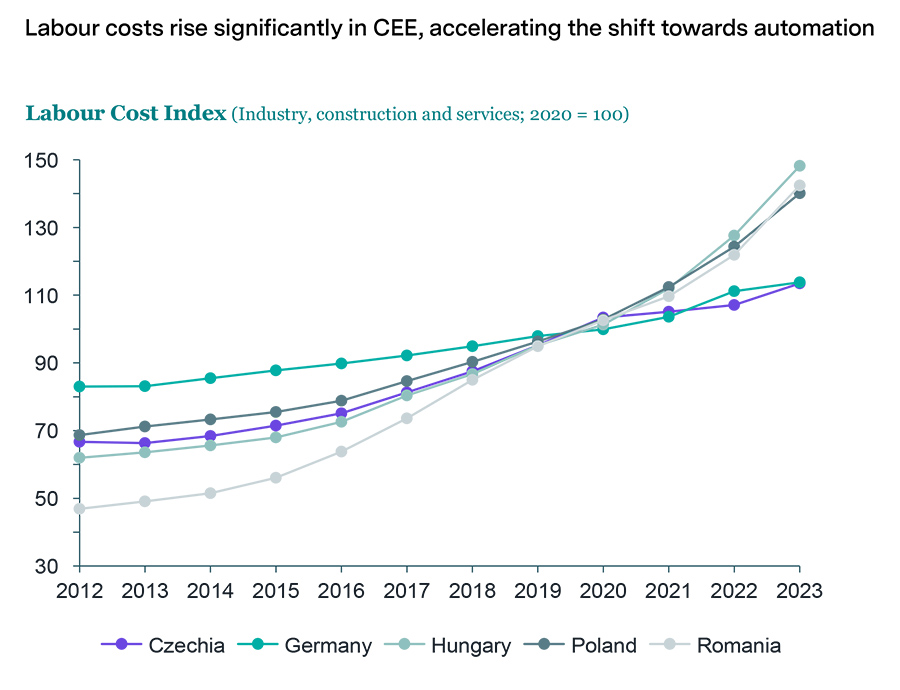
Despite that, labor costs in the region have climbed quickly in recent years. Wages in Czechia have risen nearly in step with those in Germany, while Hungary, Poland, and Romania have seen faster increases in recent years. The authors argue that this makes automation both affordable and necessary.
“Automation in the CEE region enhances flexibility, scalability, and data-driven control, creating smarter, safer, and more sustainable operations,” said James Fitzgerald, regional industrial director at iO Partners.
A second hotspot takes shape
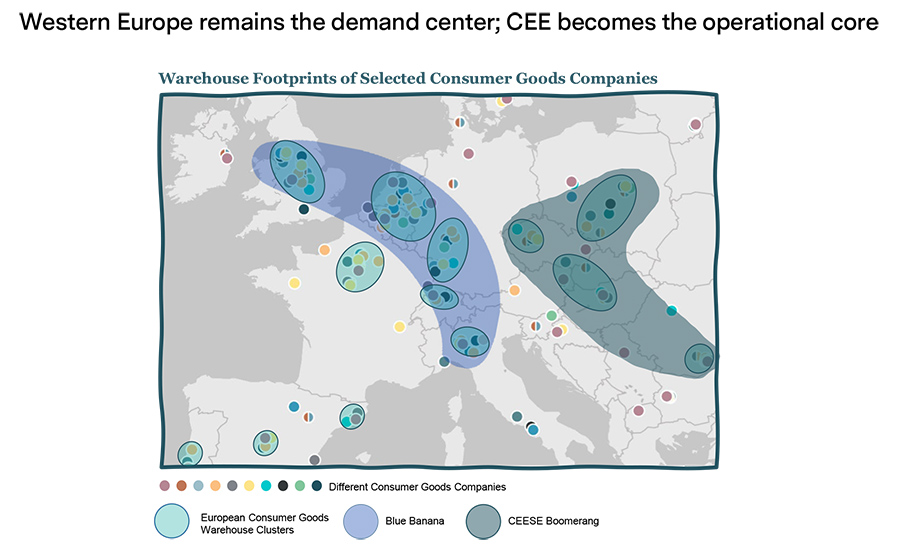
The report describes a trend it calls the ‘CEESE Boomerang’, a curved band of warehouse activity stretching across the map from Central to Eastern Europe. It is meant to sit alongside the traditional Western European corridor, often nicknamed the ‘Blue Banana’, which runs from England through the Benelux countries and Germany into northern Italy.
Western Europe is expected to remain the main source of demand, while the eastern arc becomes a second center for operations.
Consumer goods and retail companies facing shortages and rising costs in the West are expanding eastward, the authors say. They stress that these firms are rebalancing their networks rather than moving out of Western Europe altogether.
Czechia in the spotlight
The authors single out Czechia, along with Poland, as the standout performer in the CEE region. Its main strength lies in its closeness to Germany. Parcel delivery times from western Czechia to Germany match domestic German delivery times, and full and part truckloads reach Germany within two days.
Regions such as Pilsen, Cheb, and Ústí and Labem host distribution centers for global brands including Amazon, Tchibo, H&M, ZF Aftermarket, and Zalando, linked to Prague and Germany by major highways and rail routes.
Czechia is also well suited to industries that need moderate amounts of energy, skilled staff, and quick permits, the report says. It names automotive and electric vehicle supply chains, advanced manufacturing, precision engineering, and clean technology as strong fits, helped by government incentives and stable nuclear-backed power.
“Czechia’s logistics sector has evolved from peripheral advantage to core enabler of European resilience,” commented Julian Maasmann, partner at Miebach.
The road ahead
Automation is considered to be the next phase of growth for the region’s supply chain landscape. Automated storage systems have become standard in large distribution centers, self-driving robots are gaining ground in factory logistics, and compact cube-shaped storage systems are now widely used. AI is also being applied to route planning and demand forecasting.
One challenge stands out. Countries in the region must make sure their permitting rules allow buildings taller than 18 meters, which more advanced systems require. The report also notes that power stability and environmental standards will stay important, and that modern logistics parks increasingly include renewable energy and green certifications as a matter of course.
The authors conclude that the question for businesses is no longer whether to invest in the region, but how quickly to act. "The mix of affordability, innovation, and geographic advantage positions Central and Eastern Europe as Europe’s next logistics powerhouse,” concluded Maasmann.