Humanoid robots grab headlines, but investment flows to specialized physical AI

While fully-functional and intelligent humanoid robots have been hyped up and are seen as the ultimate goal of AI in robotics, the wider market for physical AI is much broader and growing rapidly, according to a new report from Arthur D. Little.
Humanoid robots (mainly in China) made a splash in headlines this year performing choreographed kung fu demonstrations and running half-marathons, but many of these displays are preprogrammed or remote-controlled. The Arthur D. Little report points to a future in which intelligent machines operate alongside humans and found that business value will first come from specialized ‘physical AI’, rather than humanoids.
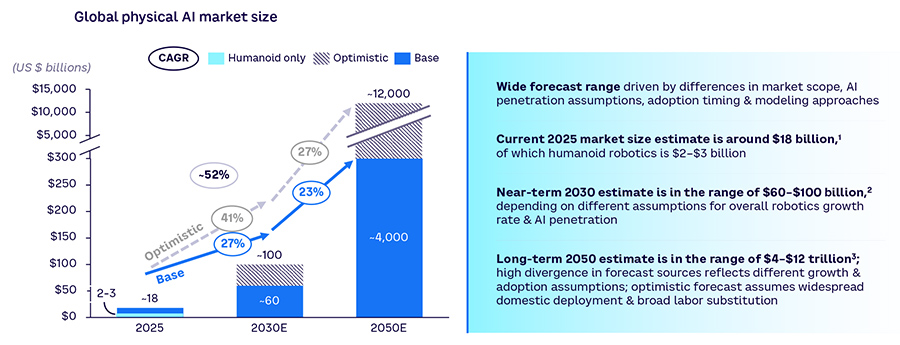
Physical AI refers to autonomous and versatile robots that can perceive, decide, and act in the physical world. The market for physical AI is currently valued at around $18 billion, compared to only around $3 billion valuation of the humanoid robot market. That could grow to up to $100 billion by 2030, with a CAGR of over 20%, according to Arthur D. Little.
Bullish on physical AI
The report defines physical AI by the intelligence built into a machine rather than its shape. It includes fixed systems in factories, mobile robots in warehouses, self-driving vehicles, and inspection drones.
Humanoids make up only about 10% of the market today. Even so, investors are betting big. Robotics venture capital reached almost $28 billion in 2025, and the valuation of humanoid maker Figure AI rose a stunning 1,200% in less than a year. The report warns that robotics demos, though impressive, are not proof of deployment readiness, and the real test is safe, repeatable, and cost-effective operation on the job.
“The most credible near-term value lies not in full autonomy, but in transforming workflows and automating tasks,” said Shane McArdle, CEO and president of Falkor, a leading industrial software company.
China is leading in several areas in robotics, with more than 80% of humanoid installations in 2025 coming from Chinese firms. The US is strongest in AI models, computing power, and capital, while Europe and Japan are comparatively strong in industrial systems.
Robotic arms in factories
Labor shortages, shifting work preferences, and the need for resilience are pushing companies toward robots. Cheaper hardware helps too. A light robot arm that cost $25,000 to $35,000 a decade ago can now be bought from Chinese suppliers for less than $10,000.
Despite that, there are still a lot of major barriers. Robotic hands still fall short of the human hand, training data from the physical world is hard to gather and apply across settings, no single use has proven broadly attractive, and rules on safety and liability are unsettled. The report therefore sees the best early opportunities in structured settings with some variety, such as factories and warehouses, where wheeled or arm-only machines are likely to scale first.
Healthcare shows strong potential but remains high risk. In the longer term, humanoids could still become scalable and dominate parts of the market if their cost, power use, autonomy, and dexterity improve enough. Experts cited in the report believe capable home robots are unlikely to be widely available for at least 15 to 20 years.
Critical uncertainties and future scenarios
The report lists factors that add to the uncertainty in the future of robotics, but two matter most: How quickly technology breakthroughs arrive, and how fast deployment grows.
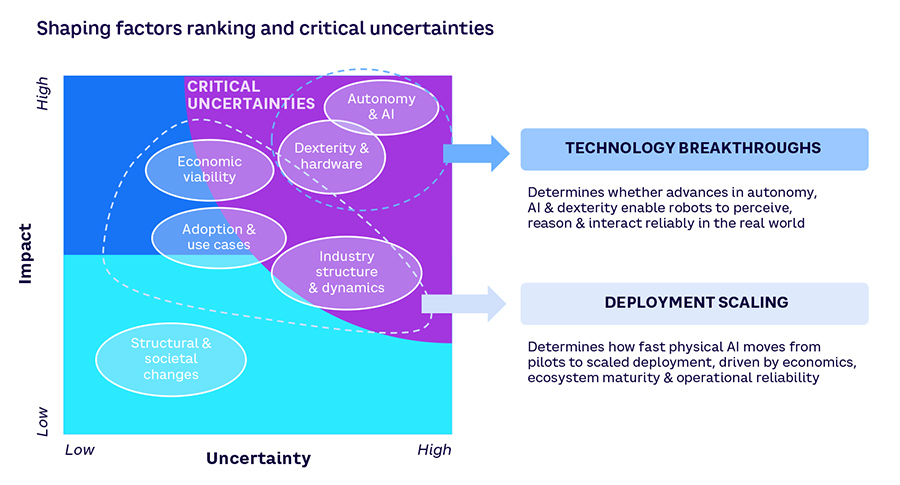
There are various future scenarios. In what the report calls ‘Incremental Automation’, both technology breakthroughs and deployment move slowly. In a scenario defined by ‘Industrial Workhorses’, deployment grows quickly in factories and warehouses without major breakthroughs, which the report says will likely be the most commercially viable path over the next decade.
In ‘Specialized Intelligence’, robots become highly capable in narrow areas but spread slowly. Then there is ‘Autonomous Abundance’, both advance quickly, though the report says this should not be treated as the default outcome.
Whatever the future holds, structured industrial settings, teams of humans and robots, and a variety of robot designs will define the next five to 10 years.
“When it comes to physical AI, humanoids are the moonshot attracting attention, capital, and talent,” said Albert Meige, director at Arthur D. Little.
“However, real-world value lags their hype. Instead, benefits are coming from specialized physical AI systems designed for specific, high-value tasks in industrial and operational environments. Critical uncertainties around technology breakthroughs and the speed of deployment mean the future of physical AI is not clear. However, companies should act now to prepare themselves, deploying early and learning fast.”