Aging power grids are putting energy reliability at risk

Much of the world’s electricity infrastructure was built decades ago for a power system very different from today’s. As a result, the gap between what aging equipment was designed to deliver and what the grid now demands is widening rapidly, write experts from OHROS Consulting Group. For grid operators, the pressing question is which assets to renew first, and on what evidence.
Most overhead power lines are designed to last 40 to 60 years. According to the latest ITAMS benchmark that OHROS Consulting Group based on data from transmission operators worldwide, half of the typical operator’s high-voltage overhead lines and towers are already older than 40 years.
The result of this aging infrastructure is more frequent outages, costly emergency repairs and constrained network capacity.
Why age matters
Large parts of Europe’s energy infrastructure were built in the 1960s and 1970s, which means many critical assets are now 50 to 60 years old. Transformers, cables, switchgear and protection systems wear down over time, and their failures become harder to predict.
Older equipment becomes less predictable, more expensive to maintain and less able to handle the demands placed on modern grids.
Design life and actual service life are two different things. Most overhead lines are designed to last 40 to 60 years, and well-maintained ones can run for 70 or even 80. Underground cables have a shorter expected lifespan of 25 to 40 years, depending on the insulation and how they were installed. A line in a mild climate with good upkeep may outlast its design life, while one exposed to harsh weather, heavy use or deferred maintenance may need attention well before the 40-year mark.
The hidden cost to reliability
Performance on aging grids usually slips gradually, with higher fault rates on older cables, longer restoration times after incidents and growing reliance on manual work that should be automated. Operators can end up stuck in a cycle of fixing failures rather than preventing them, which becomes unsustainable both financially and operationally.
Aging equipment also often runs at reduced capacity. A transformer with insulation damage or a line limited by aging conductor material shrinks the usable capacity of the network. This loss often goes unnoticed until it becomes a serious limit during peak demand or periods of high renewable generation.
The risks feed on each other. Unplanned outages, safety hazards such as fires and electrical arcing, rising maintenance costs, tougher regulation and poor investment choices all grow worse the longer old assets stay in service without a plan. Emergency repairs and outage costs are consistently higher than planned replacement or refurbishment, so running assets past their economic life is rarely the money-saver it may seem to be.
Pressure from the energy transition
The shift to renewable energy complicates these problems further. Old grids were built around predictable, centralized power plants. Solar and wind generation spread across many locations changes that reality, sending power in both directions through substations that were most often designed for one-way flow. Protection systems set up for conventional plants may also not respond correctly to newer forms of generation.
Electric vehicles and heat pumps add further demand. A line that could have served its area for another decade may need to be replaced sooner. Long lead times for transformers and switchgear mean that a renewal decision delayed today can become an unplanned outage tomorrow.
The window to act is narrowing, and organizations that delay renewal programs now will face a harder problem in five years.
Knowing when to repair and when to replace
Utilities decide when a line needs replacing by combining condition checks, drone surveys, testing, fault history and cost analysis – age alone is not enough. Repairs make sense for a sound line with a local problem, such as a damaged insulator or a corroded fitting. Replacement becomes the right choice when repair costs keep climbing, spare parts become unavailable, the line can no longer meet current or future capacity needs, or the risk is no longer acceptable.
A 40-year-old asset that is well maintained and sits in a low-risk spot may deserve a different decision than a 25-year-old asset in a critical location that is already showing early signs of damage. Getting the call wrong in either direction can end up being a costly mistake.
What the benchmark data shows
Benchmark data from OHROS Consulting Group on 12 grid operators worldwide shows that age does take its toll on individual assets. For power lines older than 60 years, half of the operators rate their condition as fair or poor. For lines younger than ten years, only one in twelve does. Yet when whole networks are compared, average age explains almost none of the difference in condition. How a network is managed matters more than how old it is.
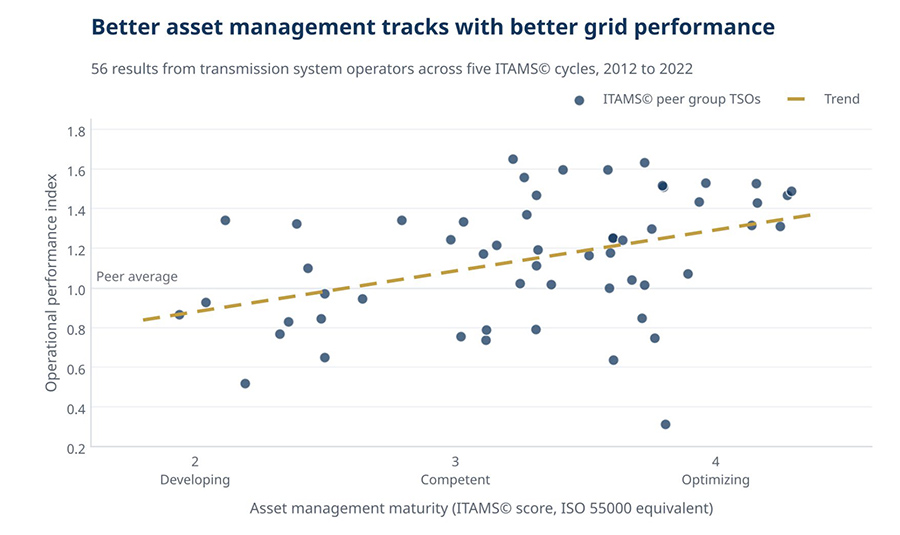
The same benchmark program tests this directly. It measures how mature each operator’s asset management is and compares that with operational results such as reliability, availability and CAPEX delivery. Across the data from 2010 to 2024, each step up in asset management maturity tracks with around 10% better operational performance.
A smarter way forward
The benchmark evidence points to management practice, so the response starts there. It rests on four practices.
Prioritize renewal on risk. Condition shows how likely an asset is to fail. Criticality shows what that failure would cost customers, safety and the business. Together they decide which assets come first, and age becomes one input among many.
Maintain on evidence. Inspections, testing and digital monitoring give early warning of trouble, so crews act before a failure instead of after it.
Treat flexibility as an asset. New options let operators get more out of the network they already have. Dynamic line rating uses real-time weather data to unlock spare capacity on existing lines. Battery storage and flexible connection agreements, in which large users and producers accept limited curtailment at peak times, can relieve pressure on a congested or aging asset. These measures can defer replacement or reinforcement and buy time to plan it well.
Assets keep aging all the same, so flexibility works best inside a renewal plan, as a way to sequence it.
Make replacement a strategic choice. When an old overhead line reaches the end of its life, a like-for-like swap is rarely the best answer. Utilities now weigh higher-capacity conductors on existing towers, underground cables, high-voltage direct current technology or a different route, based on what the future grid will need.
All four depend on the same capability, which is clear ownership of asset decisions, reliable asset data and people trained to act on it. That is what separates operators that stay ahead of their aging grids from those that fall behind.