Why AI is rewriting the economics of digitisation in the SME market

Many SMEs see the potential of digitalisation but still struggle with cost, complexity and uncertainty. According to Tom Joseph, AI Consultant at Crux Digits, AI is fundamentally changing that economic equation – making bespoke solutions faster and more affordable, and prompting companies to rethink how they use technology.
Ask a director of a small and mid-sized business (SME) why order intake, quotations or compliance reporting still aren’t automated, and you rarely get a technology answer. You get an economic one: the current system works.
It does work. That is precisely the problem. Somebody built a spreadsheet in 2014, somebody else added a macro, a planner learned which customer emails mean what, and the whole thing now runs on habit, institutional memory and one person who knows where everything is. Not elegant, but functioning, paid for, and understood. Sound familiar? Against that, any proposal to change carries all the risk.
Increasingly however, SMEs are turning to artificial intelligence to re-assess that equation. Figures from advanced European economies show that a growing number of SME businesses are using AI technology, from around one third at small-sized businesses to above 65% at mid-sized businesses.
Yet challenges in the execution phase are holding back faster and broader AI progress. The key bottleneck is lack of experience.
The calculation that stops the project
Put yourself in the director’s chair. You see the upside: faster throughput, fewer errors, capacity without headcount. And still the project dies at the same point, the moment someone runs the numbers on what it takes to get there.
Process automation means mapping the process first. Digitisation means auditing what the data actually looks like, not what the manual says it looks like. Both mean months of discovery, workshops, a system integrator, licence commitments, and a change programme for the people who have to work differently afterwards.
And there is no shortcut, because the process is genuinely unique. A logistics operator’s intake flow is not a horticulture wholesaler’s intake flow. Off-the-shelf software covers perhaps 70%, and the remaining thirty is where the actual business lives: the exceptions, the customer-specific rules, the knowledge that exists only in someone’s head. Closing that gap has always required a consulting effort, billed by the hour, over a timeline long enough that the business case erodes before the system goes live.
And you know how such projects tend to end. McKinsey & Company and the University of Oxford studied more than 5,400 large IT projects and found an average cost overrun of 45% and a schedule overrun of 7%, while delivering 56% less value than predicted. 17% ran so far off – 200% to 400% over – that the researchers called them black swans: projects capable of threatening the company’s existence.
Notice what is really happening here: under hourly billing, that entire overrun risk sits with you, the client. Your hesitation was never about technology. You are refusing, correctly, to finance someone else’s uncertainty.
So you keep the spreadsheet. For twenty years, that was frequently the right call. This caution is not conservatism. It is a correct reading of the historical record.
AI does not change that by itself. MIT’s study The GenAI Divide, built on 300-plus public AI initiatives, 52 organisational interviews and 153 executive surveys, found that 95% of generative AI pilots produce no measurable P&L return. Anyone answering “let’s just run an AI pilot” is offering you a ticket in a lottery you are statistically almost certain to lose.

What the data says does work
The same MIT research shows what the successful 5% do differently. Three findings stand out, and all three cut in the mid-market’s favour.
External partners beat internal builds two to one
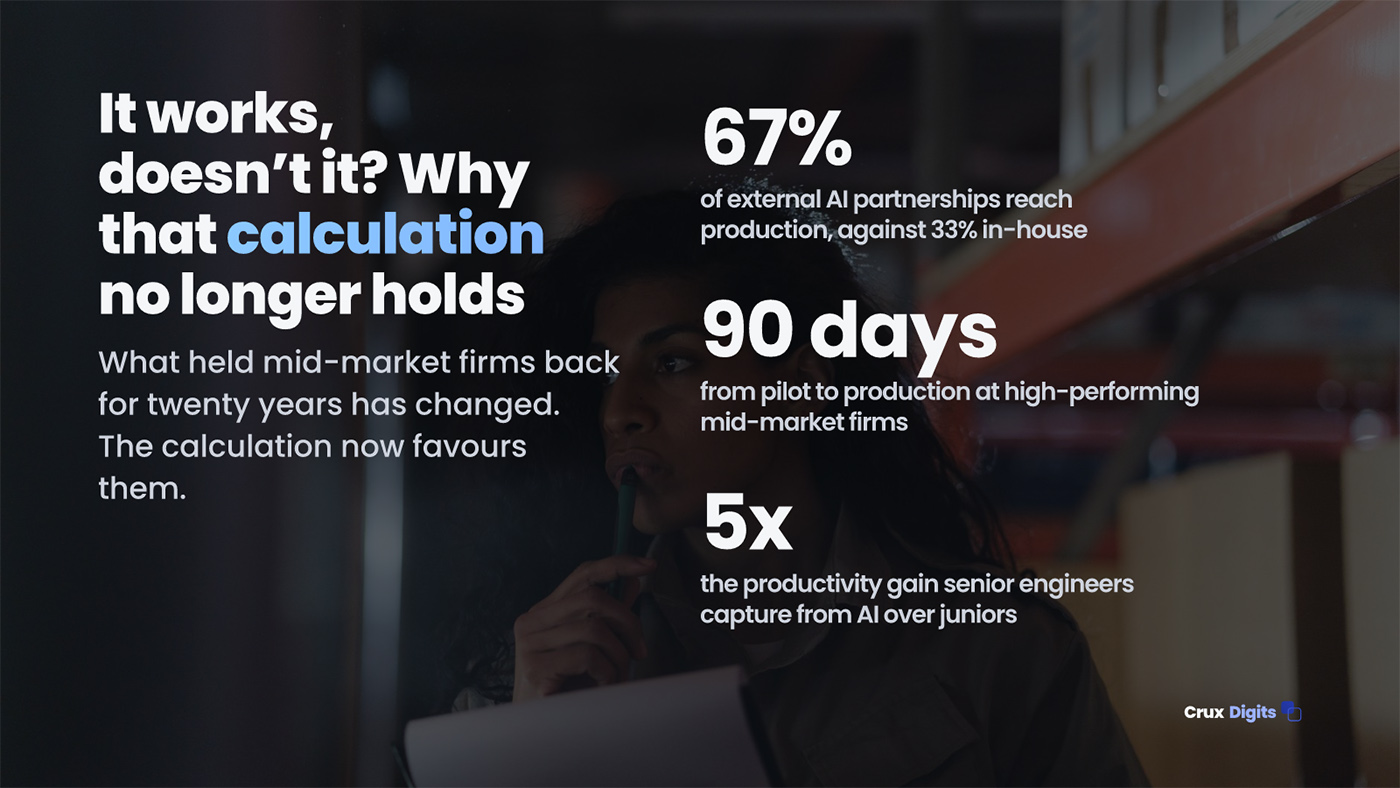
External partnerships using customised, workflow-adaptive tools reached deployment roughly 67% of the time. Internally built tools reached deployment roughly 33% of the time. For a mid-market firm with no in-house AI team, that is not a constraint but an advantage: the highest-probability route is the route you were going to take anyway.
The mid-market moves faster than the enterprise
Firms above $100 million in revenue take nine months or longer to move from pilot to production. High-performing mid-market firms do it in around 90 days. Fewer governance layers, shorter reporting lines, one decision-maker. The structural disadvantage of the SME in IT (no scale, no department) inverts into a structural advantage here.
The value sits in the back office, not in marketing
MIT found the highest returns in operational and back-office automation, not in sales and marketing, where most budget goes.
What actually changed
The variable that has moved is not the software. It is the cost of building the bespoke 30%.
Large language models and coding agents have collapsed the effort required to produce custom logic against a specific workflow. Work that used to take a team of consultants a quarter (reading through the exception cases, writing the integration glue, building the interface, testing against real historical data) now takes a small senior team weeks. Not because the work is skipped, but because the slow, expensive part of it has been compressed.
And here is the twist: this shift helps the mid-market more than the enterprise. Large enterprises could always afford the consulting effort. The SME never could, which is why they got standard software that fitted badly, or nothing at all. The economics that excluded them have shifted.
And the evidence on who captures that shift is unambiguous. Opsera’s benchmark analysis across more than 250,000 developers at 60-plus organisations found senior engineers capture roughly five times the AI productivity gain of junior engineers. Other work, including Google’s DORA reports, shows task-level speed gains do not automatically convert into delivery gains unless review and process discipline hold, which is exactly where a senior team makes the difference.
The implication is uncomfortable for the traditional consulting model. A pyramid of junior consultants beneath one partner is precisely the team structure that benefits least from this technology. A small team of senior engineers is the structure that benefits most.
From hours to impact: why the price should be fixed
That shift ought to change how these engagements are bought, and increasingly it does.
Once a small senior team does the work in weeks rather than quarters, the timeline becomes predictable. And if the cost of building is no longer the dominant variable, then billing by the hour stops making sense for either party. Hourly billing is a mechanism for allocating uncertainty when nobody knows how long something will take: the client absorbs the overrun risk. Given the McKinsey and Oxford numbers, that is a substantial risk to be carrying.
The alternative has two parts, and they belong together.
1) The cost estimate is disclosed. Before the first conversation, not after it. A supplier who only names his number after a discovery phase is asking you to invest before you can compare. A supplier who dares to publish his estimate is saying two things at once: I can estimate this work, and there is nothing hidden in how the number is built.
2) The price is fixed, against a defined outcome. The client knows the number before signing. The supplier carries the overrun: the risk sits where it belongs, with the party that can control it. Scope discussions happen at the start, in the open, rather than as a series of change requests six months in. It also removes a perverse incentive clients have always suspected and rarely said aloud: under an hourly model, the supplier does better when the work takes longer.
A fixed price inverts that incentive: the faster and better the result, the better for both parties. Supplier and client finally sit on the same side of the table.
That is not a pricing strategy. It is the logical consequence of the new calculation: now that the hour is no longer the cost driver, the unit of account should no longer be the hour, but the impact.
Three questions
If you are weighing this up, three questions separate a serious proposal from a repackaged staffing arrangement.
Is the price fixed, against what result, and was the estimate disclosed up front? Fixed price against vague scope is a negotiation you will lose later. Fixed price against a defined, testable outcome is a commitment. And a number that only appears after the discovery phase is not transparency but theatre.
Who is actually doing the work? Given the 5:1 senior-to-junior ratio, a team pyramid is no longer an efficiency. It is a cost you are paying for. If the proposal describes a structure rather than named people, ask why.
What is running in 90 days? That is the pace at which high-performing mid-market firms demonstrably deliver. Modern delivery should produce something running against your real data inside weeks. If the first milestone is a design document or a deck, the underlying model has not changed, only the pitch.
Conclusion
The objection that “it already works” was never irrational. It was a rational response to a market in which bespoke solutions often cost more than they delivered. That market no longer exists. Even so, organisations do not have to take that claim at face value.
The best test is simple: take one process, a sample of historical data, and see whether something that works can be delivered within a few weeks and at a fixed, publicly stated price. Any serious consulting firm should be able to pass that test. If a consultancy is unwilling to do so, it is not removing the doubt – it is confirming it.