Santen on its Green Path towards a sustainable supply chain

For a global eye-health company Santen, supply chain sustainability is not a separate environmental agenda. It is part of protecting reliable patient access, strengthening resilience, improving efficiency and preparing the business for rising regulatory and customer expectations.
Santen’s long-term environmental direction is set through its vision document ‘Vision for the Earth 2050’. The goal is to achieve carbon-neutral operations by 2050. ‘The Green Path’ turns that ambition into a practical supply-chain roadmap, helping teams weigh carbon alongside quality, service, resilience, and cost.
Titty Lubrano (Head of Supply Chain for EMEA) and Alejandro Portilla (Global Supply Chain Vice President) explain the choices already being tested, the capabilities still being built, and how Impact Stewards helped along the journey.
A complex global supply chain
Titty and Alejandro both bring extensive experience in life sciences supply chains. Titty leads a 40-person team responsible for planning, operations, warehousing and transportation across EMEA, including supporting new product launches and driving operational excellence. Alejandro oversees Santen’s global supply chain activities.
Santen’s focus on ophthalmology makes this a complex operation. Alejandro: “We are a specialized company with a global footprint and a broad range of products. Our supply chain must manage different temperature requirements, liquids and surgical products, requiring agility and precision across markets.”
The importance of vision
Both are deeply connected to the impact of their work on patients. Alejandro: “Vision shapes how we experience the world. Because our treatments often come into direct contact with the eye, quality and reliable supply are essential. We have to get it right every time.”
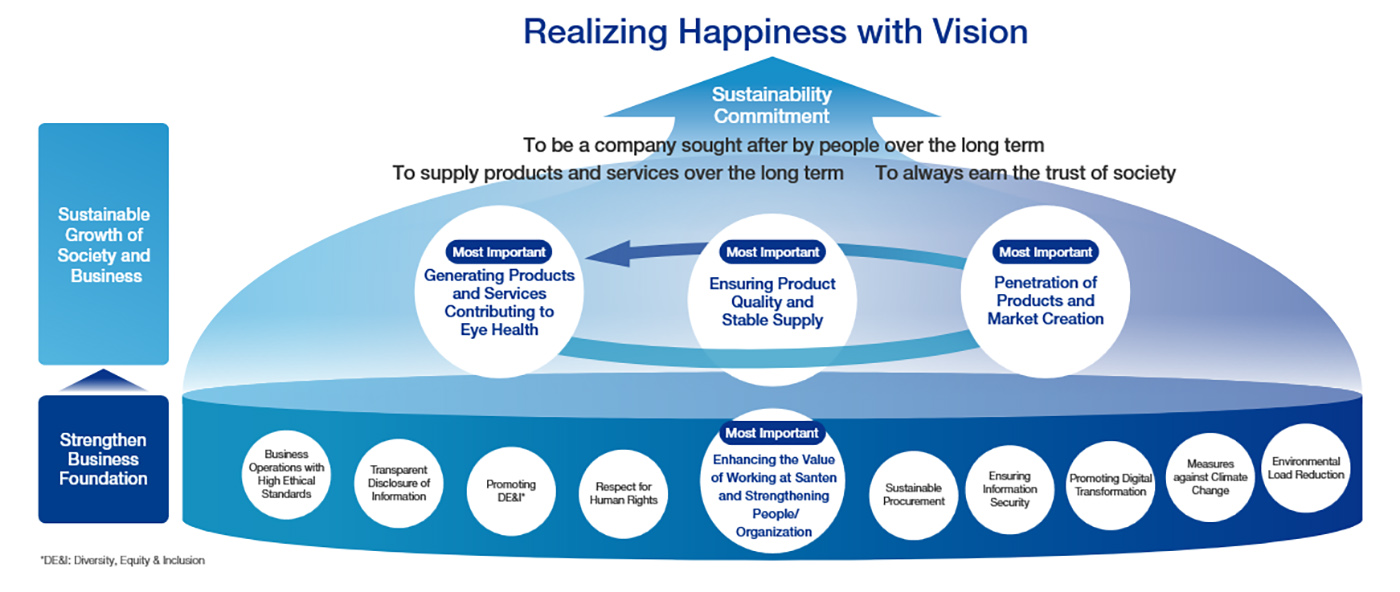
Titty: “Our purpose is to contribute to Happiness with Vision, and that extends beyond therapeutic areas. Social responsibility has long been part of Santen, from our partnership with the Japan Blind Football Association to employee volunteering initiatives supporting people with vision impairment.”
Building on the sustainability journey
As milestones toward this ambition, Santen has set 2030 targets to reduce Scope 1 and 2 emissions by 50% from 2019 levels and Scope 3 value-chain emissions by 15%.
The Green Path builds on this foundation by translating Santen’s sustainability ambitions into practical supply-chain action. Alejandro: “The question was how to embed sustainability more consistently in decisions about service, resilience, quality and cost, and focus on the changes that can make a meaningful difference.”
Titty: “The next step was to give our teams the tools and data to translate Santen’s sustainability ambitions into everyday supply-chain decisions.”
A closer look at the supply chain
As part of this work, Santen joined the Sustainable Supply Chain Initiative (SSCI), which enables life sciences supply-chain leaders to exchange practices and assess sustainability maturity.
Titty: “The benchmark gave us an external perspective on our progress and where we could go further. Santen already had established environmental commitments and activities across its operations. What became clearer was the opportunity for the supply chain to contribute more systematically.”
The assessment also reinforced that environmental and business performance can support each other. Alejandro: “We saw that carbon reduction and efficiency can go hand in hand. That encouraged us to look differently at how we design and manage our supply chains.”
This work informed the Green Path, a structured program supported by Impact Stewards. Stakeholder input and external benchmarking identified ten priority areas and shaped a roadmap of projects, capabilities, KPIs and timelines. The roadmap now provides direction; implementation and measurement will determine the scale of its impact.
Titty: “It was great to work with Impact Stewards. They brought an external perspective, challenged our thinking and helped us turn a broad ambition into a practical roadmap that our teams can act on.”
Rethinking how products move
Transportation is one area where the Green Path is informing changes. The team examined individual transport flows to reduce emissions while protecting product quality and ensuring treatments remain available when patients need them.
One early example involved selected shipments between Korea and Europe. Moving them from air to ocean reduced CO2 emissions per shipment by approximately 95%. Because ocean transit takes longer, shipment consolidation, inventory planning, and close collaboration between supply-chain and commercial teams were essential to protect timely patient access to treatment.

A second initiative is testing how pallet configurations and delivery consolidation can improve truck utilization and reduce journeys without weakening reliable product availability for customers and patients. Reporting the resulting change in vehicle fill, kilometers traveled, emissions, and delivery performance will be important to demonstrate value and guide wider adoption.
Titty: “When teams can see carbon, cost and service together, sustainability becomes part of the operational decision rather than a separate consideration.”
Sustainability in everyday decisions
The next test is execution: moving from individual initiatives to a repeatable management approach with clear ownership, comparable data, and decisions that account for carbon as routinely as cost, service, and resilience, while keeping treatment quality, availability, and continuity for patients at the center.
Titty: “As we develop this work, data will be increasingly important in helping teams assess carbon alongside cost, service and resilience. The aim is to make sustainability considerations a more consistent part of everyday supply-chain decisions.”
The Green Path has a global outlook, with some of the initial work being developed in EMEA. This reflects both Santen’s global sustainability ambitions and evolving regulatory and customer expectations around value-chain emissions in Europe.
Alejandro: “This is not a compliance exercise. Our ambition is to make lower-carbon choices part of how we design and manage the supply chain, without compromising quality or reliable patient supply. The roadmap is in place; our focus now is disciplined delivery and transparent measurement.”
Tim van Rees, partner at Impact Stewards and lead of the Sustainable Supply Chain Initiative, said: “The Green Path brings supply-chain, commercial and sustainability perspectives together to test where environmental gains could also strengthen the business. This gives Santen a practical basis for prioritising the changes that can deliver the greatest impact.”