Impact Stewards launches the Sustainable Supply Chain Benchmark

Impact Stewards has launched the Sustainable Supply Chain Benchmark, a new framework that gives life sciences companies insight into where they stand on their supply chain sustainability journey.
The launch of the new benchmark comes against a backdrop of growing pressure on life sciences companies to strengthen their sustainability performance. Regulators, investors and customers are demanding greater transparency around environmental impact, while companies are also facing increasing pressure to reduce emissions across complex global supply chains.
At the same time, sustainability is becoming increasingly tied to operational efficiency, resilience and long-term competitiveness – making it a strategic priority rather than simply a compliance exercise.
Within corporate sustainability strategies, increasing attention is being paid to Scope 3 emissions, which often represent the largest share of a company’s overall emissions. These cover indirect emissions across the value chain, including those from suppliers, purchased materials, transportation, business travel, the use of products and end-of-life treatment.
For life sciences companies in particular, Scope 3 matters because they often have complex, global supply chains involving raw materials, chemicals, packaging, manufacturing partners, logistics providers and healthcare organisations. This means a company can make substantial progress in reducing its Scope 1 and Scope 2 emissions, including through the use of renewable energy, while still having a significant overall carbon footprint.
Sustainable Supply Chain Benchmark
To help life sciences leaders advance their sustainability goals, the Sustainable Supply Chain Benchmark has been developed by Impact Stewards, a Dutch-origin life sciences and healthcare consultancy firm.
The benchmark is part of its Sustainable Supply Chain Initiative, a network that brings together supply chain leaders from a wide range of life sciences companies to learn together, share experiences and foster joint initiatives.
“We launched the Sustainable Supply Chain Initiative in 2024 with pioneering leaders from six life sciences companies, and the network has since grown into a movement with around two dozen companies,” said Tim van Rees, partner at Impact Stewards. “Sustainability is a major topic on the agenda of leaders, and through this benchmark we’re giving them the framework and tools to plan for and achieve their sustainability goals.”
The benchmark works as follows: leaders self-assess their supply chain performance across seven dimensions. Based on this input, Impact Stewards develops a snapshot of where a company stands relative to its industry peers and global best practices. “The insights are coupled with action-driven recommendations, so leaders can get started right away.”
The dimensions
The Sustainable Supply Chain Benchmark evaluates progress and maturity along seven key sustainability aspects. Per dimension, van Rees shares his view on common observations.
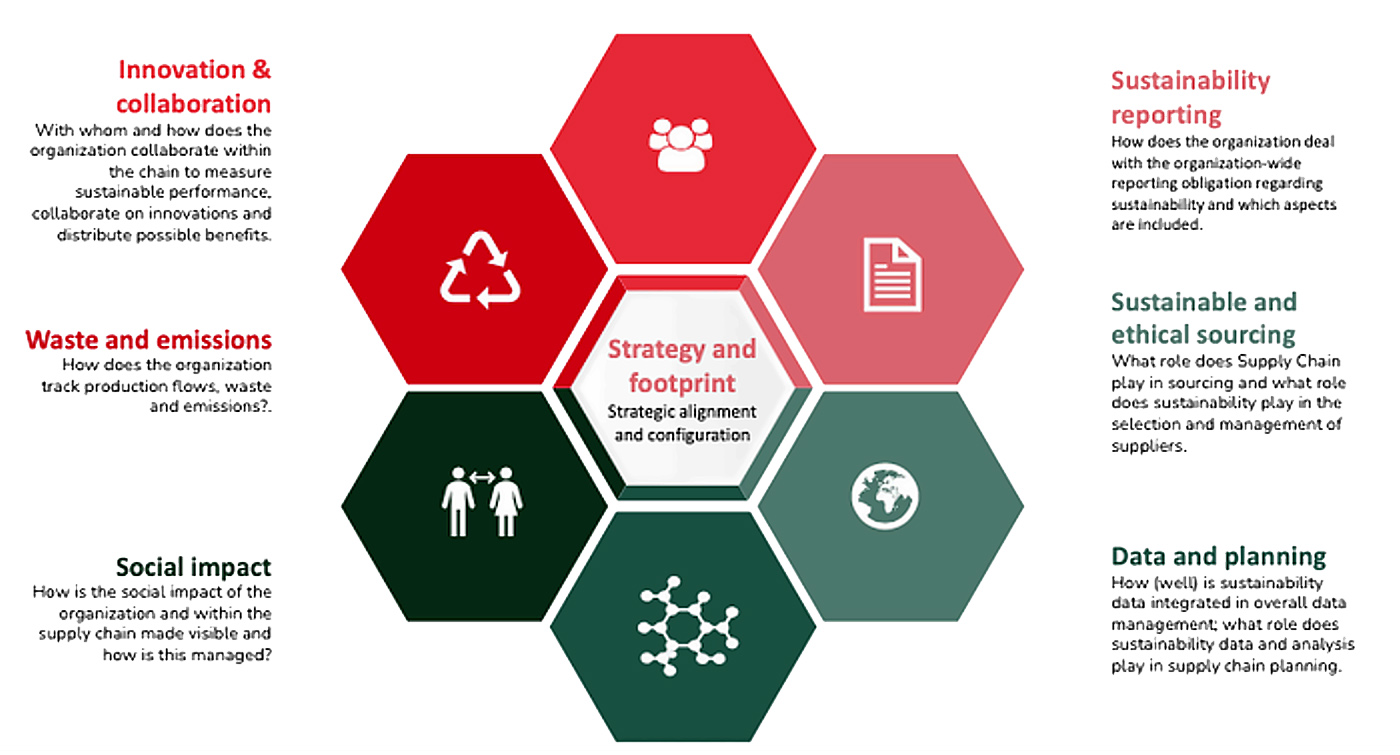
Strategy and footprint looks at strategic alignment and supply chain configuration.
“We observe that supply chain configurations are not frequently evaluated for their business and carbon impact – this is a missed opportunity. Part of the problem is that IT systems do not support the evaluation of supply chain strategic performance or ‘customer carbon-to-serve’. In addition, participants could do better at involving internal and external stakeholders in the Scope 3 strategy.”
Sustainability reporting addresses how the organisation meets its sustainability reporting obligations.
“We observe that all participants comply with the new European Sustainability Reporting Standards (ESRS). However, we notice that the supply chain function does not consistently monitor and report the emissions of its value chain. Nor are sustainability initiatives and targets formally or regularly reviewed by senior leadership.”
Sustainable and ethical sourcing involves supply chain’s role in sourcing and the role of sustainability in selecting and managing suppliers.
“We observe that the supply chain function plays a key role in sourcing and procurement, particularly in supplier logistics performance. Most – but not all – suppliers comply with specified ethical, environmental and quality criteria. However, most participants do not yet have initiatives in place to ensure supply chain resilience and minimise supply risks.
Data and planning assesses how well sustainability data are integrated into overall data management, analysis, and supply chain planning.
“We observe that, generally, a set of relevant KPIs and data is available to monitor supply chain performance. There are initial ideas on how to monitor the supply chain carbon footprint, but these are not formally integrated into the supply chain KPIs. Sustainability trade-offs still need to be effectively integrated into supply chain decision-making and planning.”
Social impact considers how the social impact of the organisation and within the supply chain is made visible and how this is managed.
“We observe that, in general, participants are proactively driving initiatives to improve social impact. Social impact is also defined outside the organisation as a relevant aspect of managing partners. However, there is no clear definition of social responsibility within the supply chain, nor are there measurable goals yet.
Waste and emissions explores how the organisation tracks production flows, waste and emissions.
“We observe that all participants monitor waste and emissions within the boundaries of their own assets and processes. However, there are no concrete examples of successful emissions or waste reduction projects or partnerships yet. Nor are there specific emissions or waste reduction targets for the supply chain.”
Innovation and collaboration sheds light on how and with whom the life sciences organisation collaborates to measure sustainable performance, collaborate on innovations, and distribute possible benefits.
“We observe that efforts are in place to align supply chain goals and objectives with key suppliers and logistics service providers (LSPs). In addition, all participants actively engage with suppliers and partners to encourage emissions reduction practices. However, there are no concrete examples of successful collaborative projects or innovations aimed at reducing carbon emissions in the supply chain – yet.”